


Keep your dreams alive. Understand to achieve anything requires faith and belief in yourself, vision, hard work, determination, and dedication. Remember all things are possible for those who believe. Gail Devers
By Kenneth Ukoh, Updated February 22, 2026
How your beliefs affect your life is important because they shape your personal growth. Beliefs are fundamental to achieving anything in life because they impact how you think and feel. Your thoughts control your decisions and actions? Consequently, your beliefs indirectly create your decisions and actions. In essence, how far you can go in life and the types of challenges you are prepared to encounter are shaped by your beliefs. For this reason, it is important to examine your beliefs to avoid living below your potential, as beliefs can be real or untrue.
What Is Belief?
Consciously or unconsciously, we all have beliefs. We believe in something, whether we know it or not. You don’t have to belong to a religion to have a belief. Anything that we hold dearly that defines how we do things is a belief. According to the Council of Europe, everybody experiences life and the world we live in. Consequently, they have developed a belief from this experience, as mutually supportive beliefs may form their belief systems, such as religious, philosophical or ideological beliefs (Religion and belief, n.d.).
The APA Dictionary of Psychology defines beliefs as:
- “acceptance of the truth, reality, or validity of something (e.g., a phenomenon, a person’s veracity), particularly in the absence of substantiation.”
- “an association of some characteristic or attribute, usually evaluative in nature, with an attitude object (e.g., this car is reliable)” (dictionary.apa.org, n.d.)
Heiphetz et al., (2014) state that beliefs have many meanings that vary across disciplines, and the most common is that beliefs are a mental state that causes a person to regard particular propositions as true. They identify these three types of beliefs: factual beliefs, preference-based beliefs and ideology-based beliefs.
- Factual Beliefs. Factual beliefs refer to knowledge which is assumed to be true in some objective sense, independent of ordinary variations in perspective and preference.
- Preference-Based Beliefs. Preference-based beliefs are subjective and idiosyncratic. Unlike factual beliefs, they vary because of individual tastes, values, and emotions rather than objective, universally accepted truths. These beliefs often include a cognitive appraisal (e.g., “this is the best option”) and are common in domains like religion, ideology, and consumer choices, where personal preference drives decision-making.
- Ideology-Based Beliefs. Ideology-based beliefs are structured sets of values, ideas, and principles that shape how individuals or groups perceive, interpret, and act within the world. They serve as frameworks for understanding society, economics, and politics, often defining goals for social organisation and guiding political action. For example, religious beliefs contain elements of both fact and preference, a property common to religion. For example, different religions disagree about matters of faith, suggesting that religious beliefs reflect preferences
Additional Definitions
Psychology Today defines a belief as “…an idea or principle which we judge to be true” Psychology Research and Reference defines it as convictions that things held in the mind are true. If individuals think particular tenets are likely to be true, they are said to believe them. If individuals think particular tenets are unlikely to be true, they are said to disbelieve them. In their most basic form, beliefs are nonevaluative.”
According to the Stanford Encyclopaedia of Philosophy, “Contemporary analytic philosophers of mind generally use the term “belief” to refer to the attitude we have, roughly, whenever we take something to be the case or regard it as true. To believe something, in this sense, needn’t involve actively reflecting on it” (Belief, 2015 revised).
According to Johnathan Leicester, there are intellectualistic, dispositional, and feelings, or occurrent theories of belief. In the Journal of Mind and Behaviour 29 (3):219-239 (2008), he states that “The feeling theory is favoured.” The purpose of belief is to guide action, not to indicate truth. Decisions about actions often have to be made quickly in the absence of evidence. “Belief gives speed and economy to inquiry and counterfactual thinking”. The fact is that whether the belief is accepted as true or not, it affects how believers think and act. It affects their worldview and guides their actions (Leicester, 2008).
Daniel Kahneman, the 2002 Nobel Laureate, states, “For some of our most important beliefs we have no evidence at all, except that people we love and trust hold these beliefs. Considering how little we know, the confidence we have in our beliefs is preposterous — and it is also essential” (Kahneman, D. 2011). #
“Feelings of belief” and “occurrent theories of belief” relate to how mental states are actively experienced, held in consciousness, and processed, distinguishing them from long-term, background beliefs. Occurrent beliefs are those actively entertained or on one’s mind at a particular time, whereas most beliefs are non-occurrent
Belief and Belief Systems
Another phrase that is usually associated with beliefs and is sometimes used to mean the same thing is the belief system. The Psychology Dictionary defines a belief system as “a set of beliefs which guide and govern a person’s attitude. Usually, it is directed towards a system such as religion, philosophy, or ideology. Attitudes and beliefs in these systems are closely associated with one another and retained in memory”. Open Education Sociology Dictionary (OESD) defines it as “A set of beliefs held by a particular society, culture, or individual.”
So, a belief is an acceptance that something exists or is true, especially one without proof, while a belief system is a collection of these beliefs that a person or society holds, for example, a religious belief.
Characteristics of Beliefs
From the above definitions, we can deduce the following characteristics of beliefs:
- Personal commitment is one of the most observable and interesting features of a belief. For this reason, beliefs can vary among the believers. Some may be passionate, while others are radical.
- Beliefs may be real or unreal. However, this does not matter as the motivation for certain behaviours caused by beliefs is driven by our deeply held values. In Neuro-Linguistic Programming (NLP), beliefs are regarded as our generalised values. “The generalisations we make about ourselves, others and the world and our operating principles in it. Beliefs act as self-fulfilling prophecies that influence all our behaviours.” -Joseph O’Connor and John Seymour.
- For people who are passionately committed to their beliefs, it does not matter whether the beliefs are true; they follow the beliefs very rigidly and may even be prepared to die for them. They are not open to change.
- Beliefs are embedded in our unconscious mind, which does not question whether something is true. All it does is act on what is presented to it
- . According to the quote from Joseph O’Connor and John Seymour above, beliefs can become self-fulfilling prophecies as the unconscious mind acts to bring about the results you want.

Enhancing and Limiting Beliefs, and Their Impacts on Our Personal Growth
As the above definitions show, beliefs do not require any evidence of truth. They are internal representations of how we view the world, and some of them have been handed down to us since we were kids by our parents or guardians. For this reason, it is possible to have a wrong belief that affects us negatively. The tendency to act on beliefs rather than question them to know the truth is not a good habit.
Beliefs are critical to accomplishing anything in life because they can either inspire or limit us, depending on what we believe. If you feel that you cannot do something, you can’t because you have already limited yourself. An example I can recall is the boxing match between Mike Tyson and Michael Spinks in 1988. Both were undefeated before this fight, and many people had thought that Michael Spinks could beat Mike Tyson. Michael Spinks was knocked out in the first round. According to some boxing commentators, Michael Spinks walked into the ring a defeated person, as portrayed by his demeanour. Life can sometimes be like that when we place limits on ourselves, which may only exist in our minds, instead of in our abilities.
Even in religion, the Christian Bible provides some powerful passages about beliefs. One of them is that “‘If you can’! All things are possible for one who believes.” (Mark 9:23 – English Standard Version). It is also written in Proverbs 27:19, “As in water face reflects face, so the heart of man reflects the man” (English Standard Version). There are incredible and inspiring principles. For those who believe in God, it is thought that nothing is impossible for God to accomplish, and likewise, they can achieve whatever they want with God’s help. Also, as the heart of a man reflects a man, a person is what he or she thinks about.
Obviously, people with deep convictions in their beliefs would make decisions based on such beliefs. The three principles to learn here are:
- If you believe in something, you can achieve it if you work patiently and diligently towards it. Whether you work hard or smarter, the appropriate amount of effort is needed to achieve anything.
- Belief must originate from the heart, i.e. it should result in transformation rather than conformation. You are likely to be more inspired if you do what you love.
- Lastly, it is necessary to have a journal or a road map in life. Without it, there is no starting point or destination, and worse still, how can we measure our performance?
Everyone in life makes a journey knowingly or unknowingly. Deciding to embark on the process of personal growth is based on self-beliefs that it is what we would like to do to prosper in life, i.e. we have decided to change ourselves – behaviours, skills and thoughts to improve our performance and the outside. It also involves setting goals and objectives by specifying our expectations. So, effective and meaningful change can only take place if it comes from the inside. The inside must first be changed before the outside can change.
Beliefs and Core Self–Evaluations
Research has shown that we all have a set of beliefs known as Core Self-Evaluations, which we use to make judgments about our self-worth and capabilities, based on these four broad categories of personality traits:
- Locus of control. How much control people feel they have over their lives.
- Neuroticism. Neuroticism is a trait characterised by sadness, moodiness, and emotional instability
- Generalised self-efficacy. The ability to tackle novel tasks and to cope with adversity in a broad range of stressful or challenging situations.
- Self-esteem. How we value and perceive ourselves.
Core self-evaluations are affected by beliefs. People can have positive or negative core self-evaluations. Just as limiting beliefs can hold you back from achieving your goals, so can negative core self-evaluation. Research shows that people with positive core self-evaluation can succeed in whatever they do.
The REBT Model and Reinforcing Beliefs that Empower Us
In Rational Emotive Behaviour Therapy (REBT), it is recognised that our beliefs cause us to be upset, depressed, anxious, enraged, etc. if things go wrong. It is not the events themselves. Dr Albert Ellis, the founder of Rational Emotive Behavioural Therapy (REBT) developed the ABC Model to illustrate this.
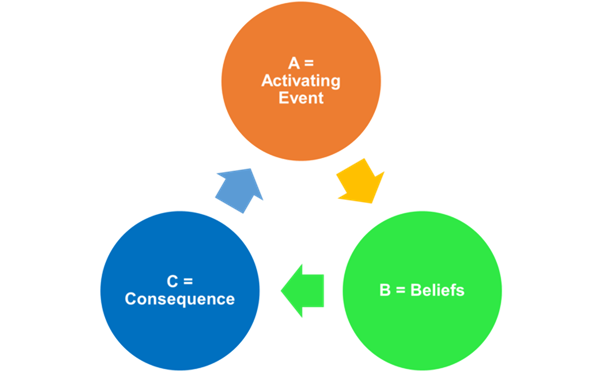
This will be illustrated by using a common example normally used in REBT lessons:
- Activating event. When something happens, for example, your employer falsely accuses you of taking money from her purse and threatens to fire you.
- Beliefs. Beliefs you have about the situation, especially irrational beliefs. For example, you believe that someone has no right to accuse you like that and that she is a “bitch!”
- Consequence. Your emotional reaction to the belief, for example, you get angry.
The idea that our beliefs upset us was first articulated by Epictetus around 2,000 years ago: “Men are disturbed not by events, but by the views which they take of them.” According to the REBT Model, in the above example, A does not cause C. It is B that causes C. It is not the employer’s false accusation and the threat that makes you angry; you believe that she has no right to accuse you and that she is a bitch. The “consequence” could have been different if your belief were different.
REBT was developed into Cognitive Behavioural Therapy (CBT), which is now widely used for treating mental disorders globally by Aaron Beck. In Cognitive Behavioural Therapy (CBT), core beliefs, which are the thoughts and assumptions we hold about ourselves, others, and the world around us, are deep-seated beliefs that often go unrecognised; still, they constantly affect our lives because they are unconsciously triggered.
As demonstrated in this discussion, beliefs are very powerful and can be harnessed to empower us to succeed, rather than leaving them to unconsciously limit our potential. Our beliefs and attitudes shape our behaviour, and our behaviour drives our actions and the results we get. These, in turn, confirm our beliefs and attitudes and the cycles continue. As already mentioned above, our beliefs can be a self-fulfilling prophecy. So, changing our beliefs changes the activating event (A) and the consequences (C).
It is important to re-examine our beliefs to ensure that our lives are not based on wrong beliefs that stop us from accomplishing our goals.
References
Heiphetz L, Spelke ES, Harris PL, Banaji MR. The Development of Reasoning about Beliefs: Fact, Preference, and Ideology. J Exp Soc Psychol. 2013 May 1;49(3):559-565. doi: 10.1016/j.jesp.2012.09.005. PMID: 23729845; PMCID: PMC3667744.
dictionary.apa.org. (n.d.). APA Dictionary of Psychology. [online] Available at: https://dictionary.apa.org/belief.
Beck Institute. 2018. Introduction to CBT | Beck Institute. [online] Available at: <https://beckinstitute.org/about/intro-to-cbt/> [Accessed 3 March 2022].
Belief (2015 revised). Stanford Encyclopedia of Philosophy. [online] Available at: https://plato.stanford.edu/entries/belief/#Bib [Accessed 17 Oct 2017]
Bell, K., 2013. belief system definition | Open Education Sociology Dictionary. [online] Open Education Sociology Dictionary. Available at: <https://sociologydictionary.org/belief-system/#definition_of_belief_system> [Accessed 1 March 2022].
Council of Europe, Manual for Human Rights Education with Young People. n.d. Religion and belief. [online] Available at: <https://www.coe.int/en/web/compass/religion-and-belief#:~:text=Everybody%20has%20beliefs%20about%20life,be%20religious%2C%20philosophical%20or%20ideological.> [Accessed 2 March 2022].
Hoffman, B., 2015. The 5 most powerful self-beliefs that ignite human behaviour. [online] Elsevier Connect. Available at: <https://www.elsevier.com/connect/the-5-most-powerful-self-beliefs-that-ignite-human-behavior> [Accessed 1 March 2022].
Jorn, A., 2016. Rational Emotive Behaviour Therapy. [online] Psych Central. Available at: <https://psychcentral.com/lib/rational-emotive-behavior-therapy#1> [Accessed 2 March 2022].
Kahneman, D. (2011). Thinking, fast and slow. New York: Farrar, Straus And Giroux
Leicester, J (2008). The nature and purpose of belief. Journal of Mind and Behaviour, [online] Volume 29 (3):219-239 (2008). Available at: https://philpapers.org/rec/LEITNA [Accessed 17 Oct 2017]
Lickerman, A. (2011). The Two Kinds of Belief: Why infants reason better than adults. [online] Psychology Today. Available at: https://www.psychologytoday.com/blog/happiness-in-world/201104/the-two-kinds-belief [Accessed 17 Oct 2017].
N., Sam M.S., “BELIEF SYSTEM,” in PsychologyDictionary.org, April 7, 2013, https://psychologydictionary.org/belief-system/ (accessed February 28, 2022).
Psychology. (2016). Beliefs (SOCIAL PSYCHOLOGY) – iResearchNet. [online] Available at: http://psychology.iresearchnet.com/social-psychology/attitudes/beliefs/. [Accessed 1 August 2020]
Psychology. (2016). Core Self-Evaluations – IResearchNet. [online] Available at: http://psychology.iresearchnet.com/industrial-organizational-psychology/individual-differences/core-self-evaluations/ [Accessed 3 Aug. 2020].
Selva, J., 2021. Albert Ellis’ ABC Model in the Cognitive Behavioral Therapy Spotlight. [online] PositivePsychology.com. Available at: <https://positivepsychology.com/albert-ellis-abc-model-rebt-cbt/> [Accessed 3 March 2022].