


“Keep your thoughts positive because your thoughts become your words. Keep your words positive because your words become your behaviour. Keep your behaviour positive because your behaviour becomes your habits. Keep your habits positive because your habits become your values. Keep your values positive because your values become your destiny” – Mahatma Gandhi
By Kenneth Ukoh, February 23, 2026
Beliefs, values, attitudes, and behaviour form a complex and dynamic system that shapes individual identity and social life. While these constructs are often examined within psychology as internal cognitive and affective processes, sociology situates them within broader cultural, institutional, and structural contexts. Understanding the relationships among these elements requires an interdisciplinary approach that recognises both individual agency and social influence. This paper explores the interconnections among beliefs, values, attitudes, and behaviour from a sociological perspective, while integrating key psychological frameworks, particularly Cognitive Dissonance Theory and the Theory of Planned Behaviour. Through theoretical analysis and real-life examples, the discussion demonstrates how internal cognitive systems interact with social structures to shape behaviour, identity, and well-being.
Conceptual Foundations
Beliefs refer to convictions or assumptions that individuals hold to be true about themselves, others, and the world. Values are enduring principles that guide judgments about what is desirable or important (Rokeach, 1973). Attitudes represent evaluative orientations toward specific objects, individuals, or behaviours and consist of cognitive, affective, and behavioural components (Eagly & Chaiken, 1993). Behaviour, in contrast, refers to observable actions. Although conceptually distinct, these constructs are interrelated. Beliefs inform values; values shape attitudes; and attitudes predispose behaviour. However, this relationship is neither strictly linear nor deterministic. Instead, it reflects an ongoing process shaped by cognitive consistency, social norms, institutional pressures, and structural constraints
Key Aspects of the Interconnection
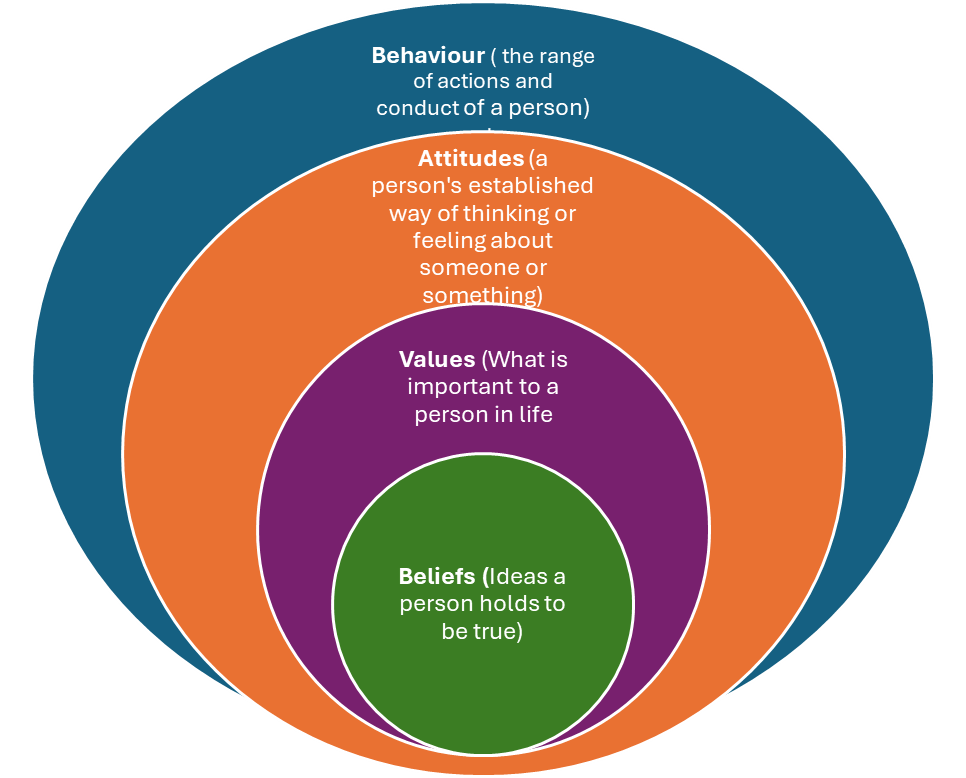
Figure 1 – The Interconnection Between Beliefs, Attitudes, Values and Behaviour
Source: Adapted from the New Zealand Immigration Advisers Authority
- Beliefs (The Foundation): These are assumptions or convictions held as true, often formed through experiences, culture, and education. They act as the subconscious building blocks for our perception of reality.
- Values (The Principles): Derived from deep-seated beliefs, values are the core principles and standards used to guide life and define personal character. They are generally more permanent than attitudes.
- Attitudes (The Expression): These are specific, conscious evaluations (likes/dislikes) of people, ideas, or events. They are the direct result of applying values to specific scenarios.
- Behaviour. Behaviour is relatively stable over time, often viewed as part of consistent personality traits, but it is not rigid. While individuals generally maintain consistent “rank-order” stability in personality throughout adulthood, their specific actions often change based on situations, context, and environment. Contextually, Behaviour changes from situation to situation because it is heavily influenced by surroundings, meaning personality is less stable across different contexts than expected.
- The Chain of Influence: The typical flow is Beliefs → Values → Attitudes → Behaviour. For example, a belief that “hard work leads to success” (belief) fosters a value for “diligence” (value), resulting in a positive attitude toward “working overtime” (attitude).
Sociological Foundations: Socialisation, Culture, and Structure
From a sociological perspective, beliefs and values are socially constructed rather than purely individual creations. Through the process of socialisation, individuals internalise cultural norms, ideologies, and expectations transmitted by primary agents such as family, education systems, religious institutions, peer groups, and media (Berger & Luckmann, 1966).
Socialisation and Cultural Transmission
Cultural contexts profoundly shape value systems. For example, individualistic societies often emphasise autonomy, achievement, and personal success, whereas collectivist cultures prioritise interdependence and social harmony. These culturally embedded values shape corresponding beliefs about responsibility, success, morality, and obligation.
A student raised in a highly achievement-oriented culture may develop the belief that academic excellence determines life outcomes. This belief supports a value placed on educational attainment, which fosters positive attitudes toward studying and academic competition. Behaviour, such as extended study hours or pursuit of advanced degrees, emerges within this socially constructed framework.
Norms and Social Control
Sociology also emphasises the power of social norms in regulating behaviour. Even when personal values are strongly held, individuals may modify their behaviour to conform to group expectations. For example, an employee who values honesty may remain silent about unethical practices in a workplace culture that discourages whistleblowing. In this case, behaviour reflects not only personal attitudes but also perceived social consequences. Structural constraints further complicate the relationship between belief and behaviour. Economic inequality, educational access, and institutional discrimination may limit the translation of values into action. Thus, sociology highlights that behaviour cannot be understood solely as a product of internal cognition; it is embedded within social structures that enable or restrict agency.
Psychological Perspective I: Cognitive Dissonance
Cognitive consistency theories propose that individuals strive for internal harmony among beliefs, attitudes, and behaviours. Cognitive Dissonance Theory posits that inconsistency between cognitions or between cognition and behaviour produces psychological discomfort (dissonance), motivating individuals to restore balance.
Mechanisms of Dissonance Reduction
When behaviour conflicts with values, individuals may:
- Change the behaviour.
- Adjust the belief or value.
- Rationalise the inconsistency.
Consider the case of smoking. An individual who believes smoking is harmful and values health, yet continues smoking, experiences dissonance. To reduce discomfort, they might quit smoking (behaviour change), minimise perceived risk (“The evidence is exaggerated”), or emphasise other values (“Life should be enjoyed”). This illustrates how behaviour can reshape beliefs just as beliefs shape behaviour.
Dissonance theory also explains broader social phenomena. For instance, individuals who initially engage in volunteer work due to external requirements may later internalise altruistic values to justify their repeated behaviour. In this way, behaviour can precede and transform values, demonstrating the dynamic reciprocity within the belief-value-attitude system.
Psychological Perspective II: Theory of Planned Behaviour
While cognitive dissonance explains post-behavioural adjustment, the Theory of Planned Behaviour (TPB) focuses on predicting intentional behaviour. According to TPB, behaviour is determined by behavioural intention, which is influenced by:
- Attitudes toward the behaviour.
- Subjective norms.
- Perceived behavioural control.
Application to Health Behaviour
Consider exercise participation among university students. A student may:
- Believe exercise improves long-term health.
- Value physical well-being.
- Hold a positive attitude toward working out.
However, if peers do not prioritise fitness (negative subjective norms) or the student feels constrained by time (low perceived behavioural control), behavioural intention may weaken. Consequently, despite positive attitudes and values, regular exercise may not occur.
TPB integrates sociological insight by recognising subjective norms—perceptions of social approval—as central determinants of action. This bridges individual cognition with social context, demonstrating how behaviour arises from both internal evaluations and perceived collective expectations.
Real-Life Case Studies
Case Study 1: Career Aspirations and Social Mobility
A first-generation university student from a low-income background may believe education is the pathway to upward mobility and strongly value financial security. These convictions foster positive attitudes toward academic success. However, structural barriers such as financial constraints, limited academic support, or family obligations may hinder performance or persistence.
This case illustrates the interplay between individual belief systems and structural inequality. Even strong alignment between beliefs, values, and attitudes does not guarantee behaviour when social conditions impose constraints. Sociology thus tempers purely psychological explanations by foregrounding structural context.
Case Study 2: Environmental Behaviour
Environmental sustainability offers another illustrative example. Many individuals express pro-environmental beliefs and values. They may hold positive attitudes toward recycling, reducing waste, or using public transportation. Yet behaviour often lags behind attitudes—a phenomenon known as the value-action gap.
From a TPB perspective, perceived behavioural control (e.g., lack of recycling facilities) and subjective norms (e.g., peers who disregard sustainability) reduce behavioural consistency. From a cognitive dissonance perspective, individuals may justify inaction (“My individual effort won’t make a difference”). This example highlights how cognitive and social variables jointly shape behavioural outcomes.

Identity, Wellbeing, and Social Integration
The alignment between beliefs, values, attitudes, and behaviour significantly influences identity formation and psychological well-being.
Identity Construction
Repeated behaviours consistent with internal values reinforce self-concept. An individual who consistently engages in community service may internalise an identity as a compassionate or socially responsible person. Conversely, persistent misalignment can produce identity confusion.
Mental Health Implications
Research suggests that congruence between values and actions is associated with greater life satisfaction and lower psychological distress (Hitlin, 2003). Chronic dissonance, by contrast, may contribute to guilt, anxiety, or reduced self-esteem. Thus, internal coherence is not merely cognitively desirable but psychologically beneficial.
Social Cohesion
At the collective level, shared value systems promote social integration. Societies with widely accepted norms experience greater predictability and cooperation. However, pluralistic societies often contain competing value systems, which may generate tension or cultural conflict. Sociological analysis reveals that belief and value systems operate not only within individuals but also as foundations of social order.
Critical Evaluation
While Cognitive Dissonance Theory and the Theory of Planned Behaviour provide robust explanatory frameworks, both have limitations. Dissonance theory may overemphasise rational cognitive processes while underestimating emotional or unconscious influences. Similarly, TPB assumes rational decision-making and may not fully account for habitual or impulsive behaviour.
Moreover, sociological critiques argue that psychological theories sometimes neglect power dynamics and structural inequality. Behaviour is not always freely chosen; economic constraints, systemic discrimination, and institutional barriers shape available options. Thus, a comprehensive understanding requires integrating micro-level cognitive theories with macro-level structural analysis.
Conclusion
Beliefs, values, attitudes, and behaviour constitute an interconnected system shaped by both psychological mechanisms and sociological forces. Beliefs inform values; values shape attitudes; and attitudes influence behavioural intentions. However, behaviour is also shaped by social norms, perceived control, and structural constraints. Cognitive Dissonance Theory explains how individuals seek internal consistency when misalignment occurs, while the Theory of Planned Behaviour demonstrates how attitudes, norms, and perceived control predict intentional action. Together, these frameworks reveal that behaviour is neither purely individual nor entirely socially determined but emerges from the interaction between cognitive processes and social context. Ultimately, alignment among beliefs, values, and actions fosters psychological well-being and coherent identity, whereas misalignment produces tension and adaptation. Understanding these relationships enhances insight into both individual development and social dynamics.
References
Ajzen, I. (1991). The theory of planned behaviour. Organisational Behaviour and Human Decision Processes, 50(2), 179–211. https://doi.org/10.1016/0749-5978(91)90020-T
Berger, P. L., & Luckmann, T. (1966). The social construction of reality: A treatise in the sociology of knowledge. Anchor Books.
Eagly, A. H., & Chaiken, S. (1993). The psychology of attitudes. Harcourt Brace Jovanovich College Publishers.
Festinger, L. (1957). A theory of cognitive dissonance. Stanford University Press.
Hitlin, S. (2003). Values as the core of personal identity: Drawing links between two theories of self. Social Psychology Quarterly, 66(2), 118–137.
Immigration Advisers Authority (2018). Personal beliefs, values, attitudes and behaviour – Immigration Advisers Authority Your tagline here. [online] Immigration Advisors Authority. Available at: https://www.iaa.govt.nz/for-advisers/adviser-tools/ethics-toolkit/personal-beliefs-values-attitudes-and-behaviour/.
Psychology Town. (2024). Distinguishing Attitudes from Values and Beliefs: A Social Psychological Perspective • Psychology Town. [online] Available at: https://psychology.town/social/attitudes-values-beliefs-social-psychology/.
Rokeach, M. (1973). The nature of human values. Free Press.